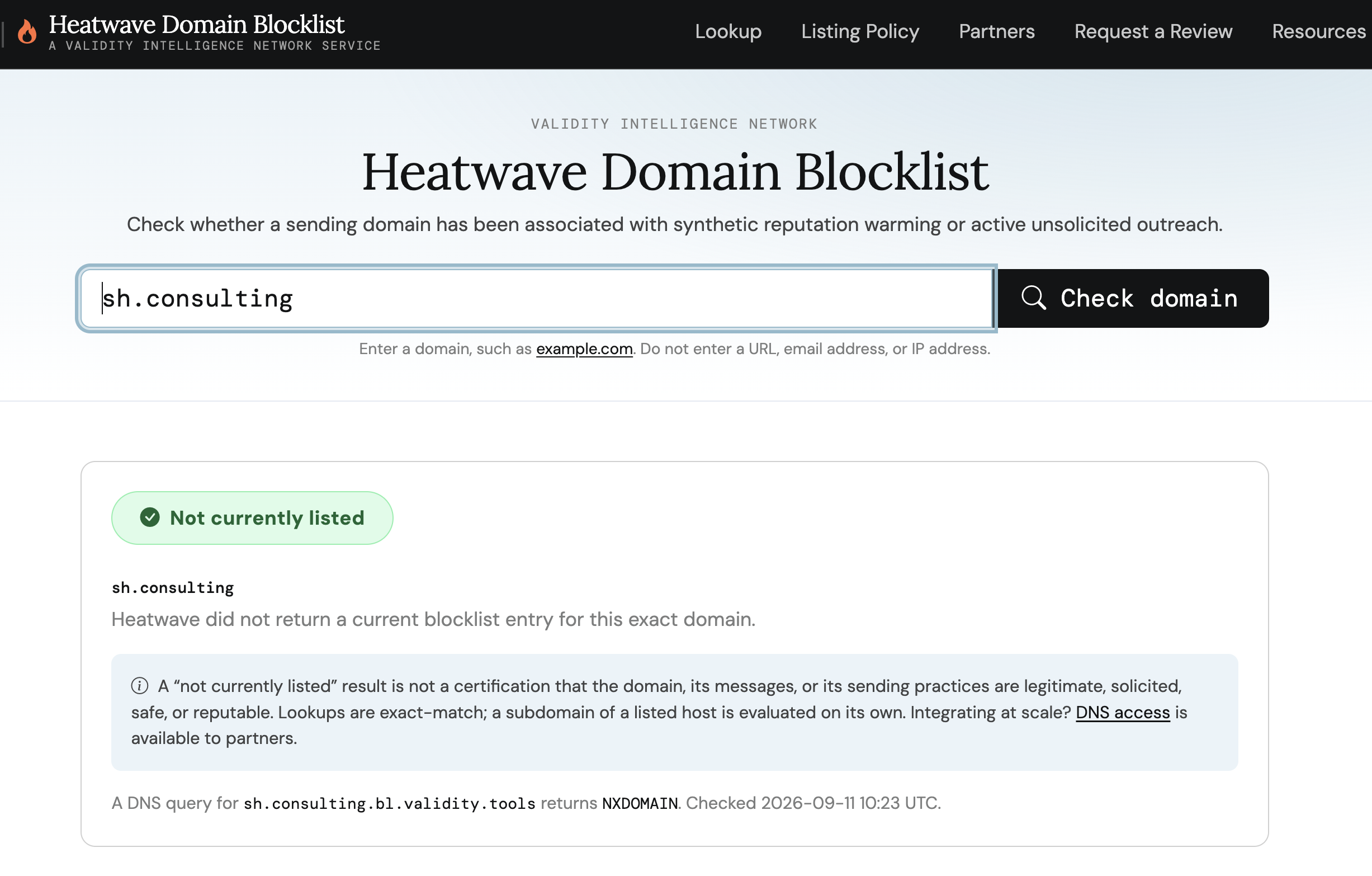


You ran a blocklist check, found your IP on UCEPROTECT Level 3, and now you're wondering how bad it is. In most cases, the honest answer is: it isn't, and there is nothing useful for you to do about it anyway.
Bottom line: a UCEPROTECT Level 3 listing does not affect delivery at Gmail, Microsoft, Yahoo, or any major provider. If your domain is listed on SURBL or Validity Heatwave, that is a different situation and does need action.
We get this question constantly. A client signs up for a blocklist monitoring tool, or runs their sending IP through a checker like multirbl.valli.org, and the report comes back with a UCEPROTECT Level 3 listing highlighted in red. Sometimes Level 2 as well. This hits senders on cloud and hosting infrastructure hardest, but anyone can cycle onto it.
The short version:
- Level 3 lists your provider's entire network (ASN), not you. Your sending did not cause it and cannot fix it.
- Gmail, Microsoft, and Yahoo do not use UCEPROTECT to filter mail.
- Search your bounce logs for rejections naming
uceprotect. If there are none, the listing is costing you nothing. - If there are none, do nothing. The listing clears on its own when the network's abuse score drops.
- Do not pay for express delisting. It changes timing, not outcomes, and the listing comes back.
The rest of this post is the evidence for those five lines, because the natural reaction to any red row on a blocklist report is alarm, and every other listing we write about deserves it. This one mostly doesn't. Understanding why requires understanding how UCEPROTECT works, because it operates unlike almost every other blocklist in the ecosystem, and treating it like a normal listing leads people to waste money on a delisting fee that fixes nothing.
What Is the UCEPROTECT Level 3 Blacklist
UCEPROTECT is a DNS-based blocklist operated out of Europe that publishes three separate zones, each with progressively wider scope.
Level 1 (dnsbl-1.uceprotect.net) lists individual IP addresses that have hit UCEPROTECT's spam trap network. This is the only level that reflects the behavior of a specific IP. Level 1 listings expire automatically, free of charge, seven days after the last abusive message was observed.
Level 2 (dnsbl-2.uceprotect.net) escalates to entire network allocations. When enough IPs within a provider's range accumulate Level 1 listings, the whole allocation gets listed, including every clean IP inside it.
Level 3 (dnsbl-3.uceprotect.net) is the one that generates the support tickets. It lists entire autonomous systems. An ASN is the full block of IP space registered to a network operator: a hosting provider, an ISP, or an email service provider. When UCEPROTECT's abuse score for an ASN crosses their threshold, every single IP announced by that ASN is listed. That can mean millions of addresses, the overwhelming majority of which have never sent a single spam message.
This is by design. UCEPROTECT's stated philosophy is that providers learn by consequence. Level 3 exists to pressure network operators into policing their own customers by making the collateral damage broad enough to hurt. Whether that pressure tactic works is debatable. What's not debatable is that your individual sending behavior has almost nothing to do with whether you appear on it.
Why Your IP Is Listed on UCEPROTECT Level 3
Because your provider's ASN crossed a score threshold. That is the entire mechanism, and it means the listing appears and disappears based on the behavior of strangers sharing your network.
The population of Level 3 shifts over time, and the shift itself is instructive. A few years ago the major ESPs practically lived on it. Our head of deliverability spent thirteen years inside SendGrid, and during that era the internal understanding was blunt: UCEPROTECT had effectively listed every ESP. If you sent through Mailchimp, SendGrid, SparkPost, or Mailgun, you were on Level 3, often Level 2 as well. The arithmetic made it inevitable. An ESP at scale hosts tens of thousands of customers across enormous ranges. SendGrid alone was running roughly 90,000 active IP addresses with another 80,000 to 90,000 in inventory, and some fraction of customers is always misbehaving somewhere in a range that size.
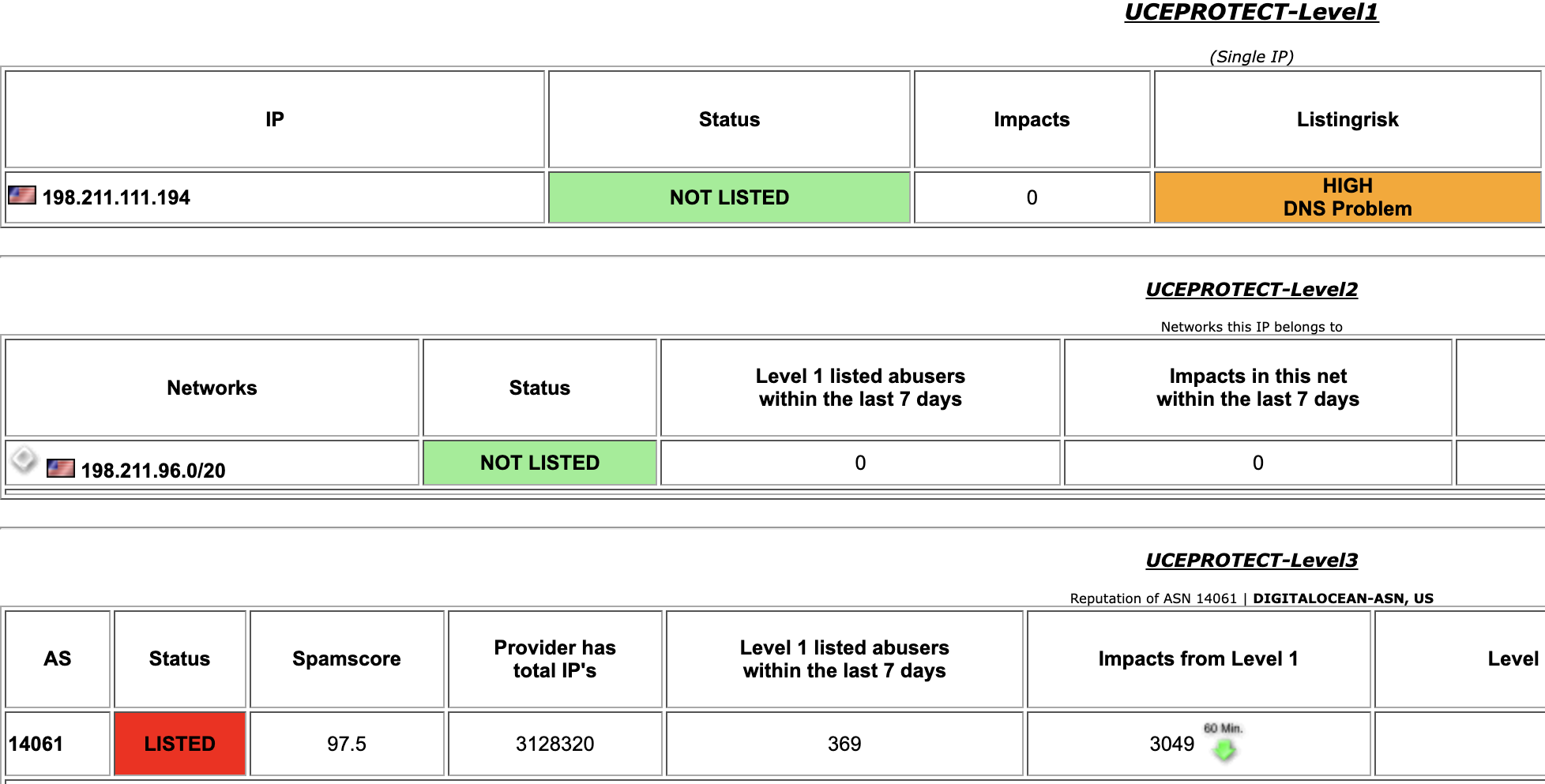
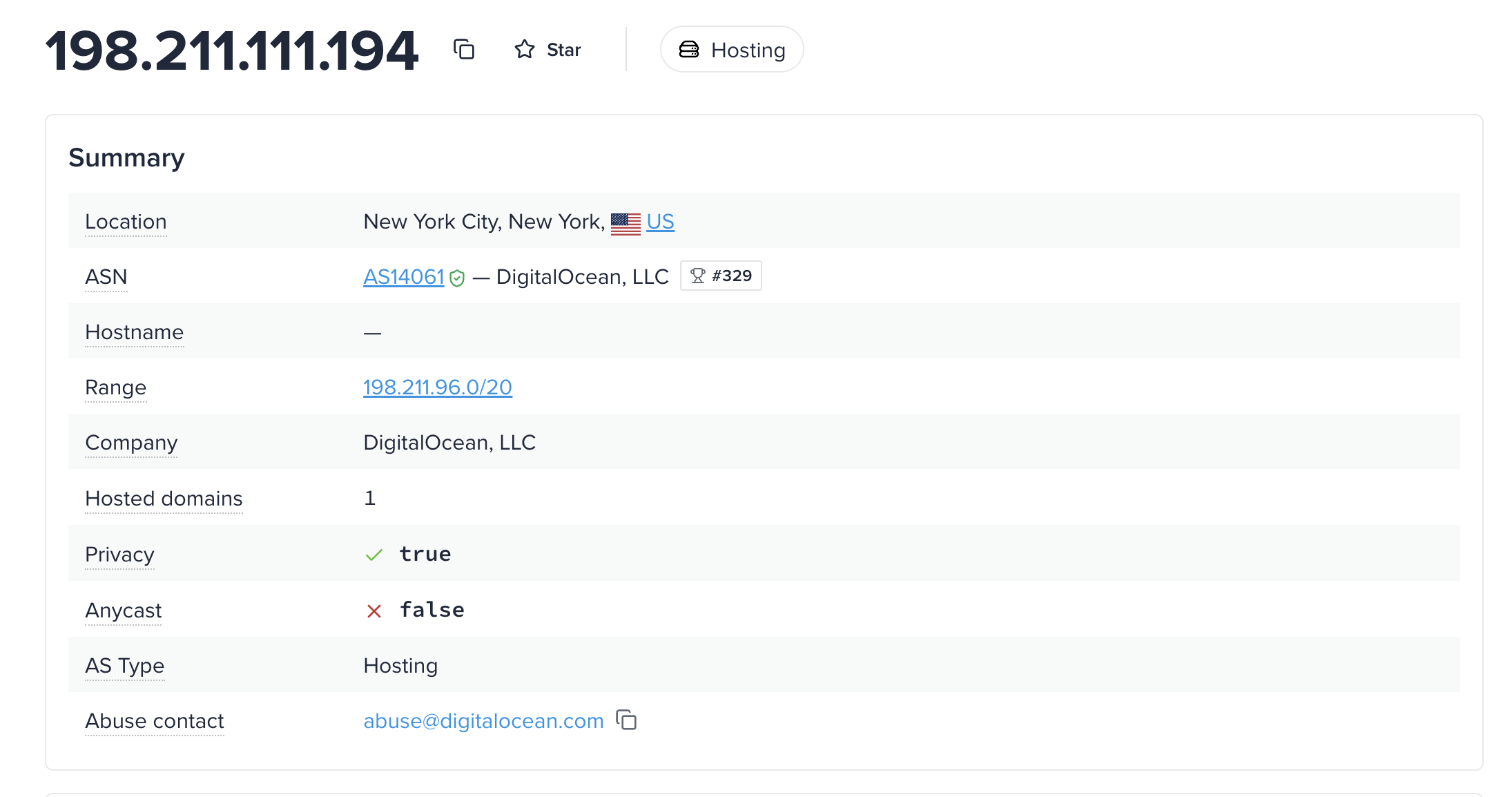
That is not the picture today. In August 2026, while writing this post, we queried the UCEPROTECT zones directly for the published SPF ranges of nineteen ESPs: SendGrid, Mailchimp, Mailgun, Amazon SES, Brevo, Constant Contact, Customer.io, MailerLite, Postmark, SparkPost, Campaign Monitor, GetResponse, AWeber, Kit, Mailjet, HubSpot, Omnisend, beehiiv, and Moosend. Every one came back clean on all three levels. The single exception in the entire sweep was ActiveCampaign, where two of five SPF blocks carried Level 2 listings: one full /24, and one /24 inside a larger /21 whose neighboring ranges were clean. No Level 3, no Level 1, and most of their infrastructure untouched, which is Level 2 working exactly as described: an allocation-level listing that says something about a slice of network space and nothing about any individual sender on it. Meanwhile OVH ranges were listed on both Level 2 and Level 3, and DigitalOcean on Level 3. Level 3 membership churns constantly, so treat these as a snapshot; the pattern is the finding, not the specific names.
The weight has moved from the big ESPs, whose compliance teams got better and whose abuse scores dropped below threshold, to large hosting and cloud providers where anyone can rent a server and run their own SMTP. Deliverability people call this the noisy neighbor problem, and Level 3 is the noisy neighbor problem elevated to policy: on a network that size, someone is always tripping a spam trap. The arithmetic of our DigitalOcean result makes the point precisely. At the time of the check, the ASN carried a spamscore of 97.5, driven by 369 abusive IPs observed within the previous seven days, out of 3,128,320 total addresses in the network. Roughly 0.01 percent of the network got the other 99.99 percent listed.
The practical consequence of that volatility is the point most write-ups miss. Your IP can join Level 3 on Tuesday and leave it on Friday without anything about your sending changing, because the score being measured was never yours. A signal that fluctuates independently of your behavior cannot tell you anything about your behavior. When your monitoring tool flags a Level 3 listing, what it is actually telling you is which network you send from and what kind of week your network neighbors are having. Nothing more.
How to Check if You're on UCEPROTECT Level 3
Two checks, two minutes, and only the second one matters.
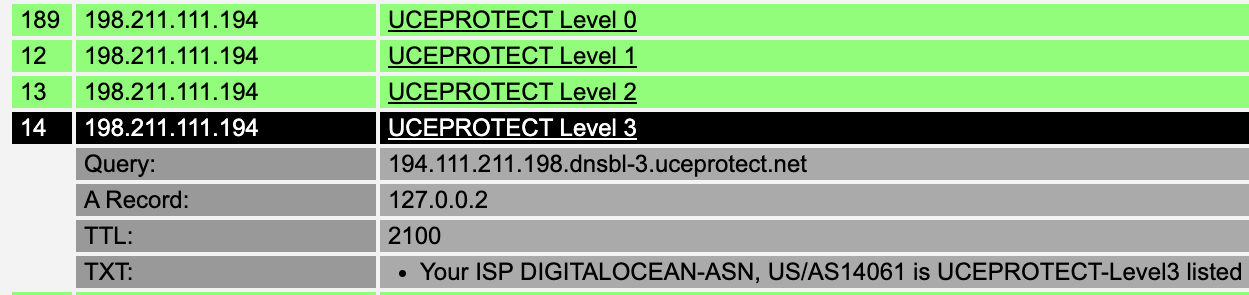
The first check tells you whether you're listed. Use UCEPROTECT's own lookup at uceprotect.net/en/rblcheck.php, which shows all three levels and, for Level 3, names the ASN and the spamscore that triggered the listing. If you prefer the command line, the zones answer standard DNS queries: reverse the octets of your IP and query the zone, so for the IP 192.0.2.15 you would run dig 15.2.0.192.dnsbl-3.uceprotect.net. An NXDOMAIN response means not listed; an answer of 127.0.0.2 means listed. Swap in dnsbl-1 or dnsbl-2 to check the other levels.
The second check tells you whether it matters, and this is the one to spend your two minutes on. Search your bounce and rejection data for the string uceprotect. A receiver that actually blocks on this list says so in the SMTP rejection, in a form like 554 5.7.1 DNS Blacklisted by uceprotect. Every major ESP exposes this: SendGrid's activity feed and bounce exports, the suppression and event logs in Brevo, Mailgun, SES, and the rest are all searchable. No hits means no impact, full stop, regardless of what the lookup in check one showed.
Does a UCEPROTECT Level 3 Listing Actually Hurt Deliverability
For the vast majority of senders, no.
The major mailbox providers do not use UCEPROTECT Level 3 to filter inbound mail. Gmail, Microsoft, and Yahoo run their own reputation systems built on complaint rates, engagement signals, authentication results, and their own trap networks. A list that flags millions of innocent IPs at once is useless to them, and they treat it accordingly. The receivers that do query UCEPROTECT tend to be smaller self-hosted mail servers and some regional providers whose administrators configured an aggressive blocklist set years ago and never revisited it.
This is why the note we include in nearly every deliverability audit reads the same way: if you run your IP through a multi-blocklist checker, you will see a small number of listings from obscure blocklist providers. This is normal, and these listings are not negatively impacting your deliverability. We have audited senders with unique open rates consistently over 70%, in the top percentile of large-scale senders, whose checker reports carried the same scattering of minor listings the whole time. The listings and the outcomes simply don't correlate.
The test that actually matters is your bounce log, the second check from the section above. A blocklist only affects you if receiving servers your audience uses are rejecting mail because of it, and those rejections name the list explicitly. If you search your bounce data and find no rejections referencing UCEPROTECT, the listing is costing you nothing, no matter what your monitoring dashboard's color coding implies. This is the same evidence standard we apply in every engagement: diagnose from rejection messages and delivery data, not from checker screenshots. It's a core part of what a proper email deliverability audit establishes before anyone touches configuration.
If you do find UCEPROTECT rejections in your logs, quantify them. In our experience they typically account for a fraction of a percent of volume, concentrated on a handful of small receiving domains. That is worth knowing about. It is rarely worth acting on.
UCEPROTECT Removal: How Delisting Actually Works and Why Paying Rarely Makes Sense
Here is where UCEPROTECT differs most sharply from every other list we deal with, and where senders lose money.
UCEPROTECT offers a paid "express delisting" service, charged in Swiss francs through external payment processors, priced per IP for Level 1 and at a substantially higher rate for network and ASN-level removals. We walked through the flow for the listed DigitalOcean ASN, and the quote to remove the entire AS from Level 3 was 449 CHF, processed through Stripe, with UCEPROTECT's own page warning that express delisting is only useful if the cause of the listing is resolved. Since the cause is 369 strangers on a three-million-address network, that warning is doing a lot of work. This pay-to-delist model is the main reason the list is controversial. Much of the deliverability industry describes it as functionally an extortion scheme, and the criticism has been consistent for years: the lists are broad enough to catch nearly everyone, and the operator charges to undo a listing you did nothing to cause.
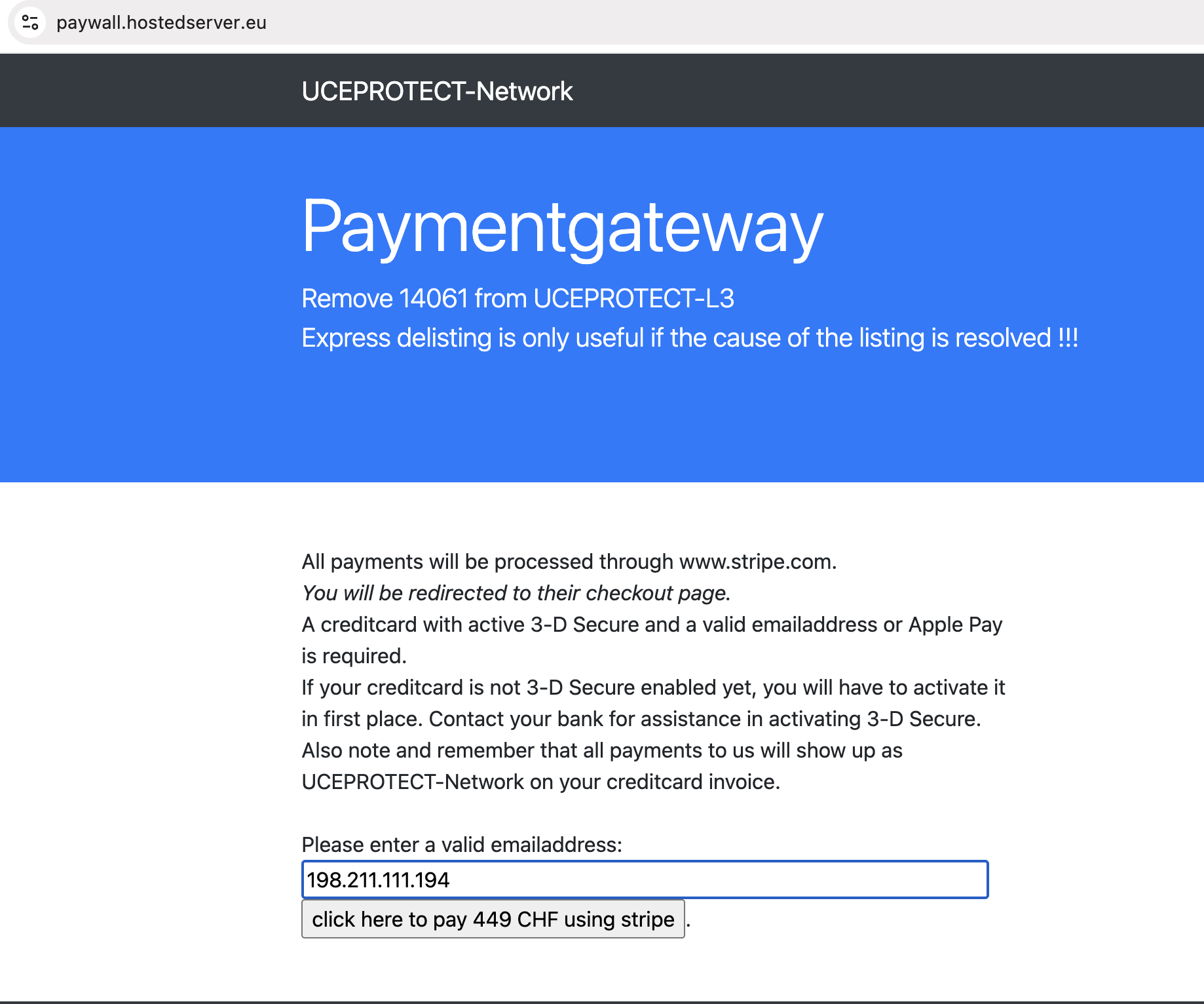
Set the ethics aside and look at the mechanics, because the mechanics alone settle the question. Express delisting only changes timing. Level 1 listings already expire free of charge after seven days without new trap hits. Level 3 listings clear automatically when the underlying Level 1 listings inside the ASN expire and the abuse score drops below threshold. Paying removes the entry immediately instead of eventually, but the moment enough neighbors in the ASN hit traps again, the score climbs back and the listing returns. On the large hosting networks that dominate Level 3 today, that cycle is continuous. You would be paying a recurring fee to briefly suppress a symptom of a network you do not control. UCEPROTECT itself will not even offer express delisting in some cases, including when the ASN ranks among the worst on their Level 3 charts.
There is one more structural point: you cannot meaningfully remediate a Level 3 listing at all, because it is not about you. Only the network operator can change the ASN's abuse profile, by terminating spamming customers and tightening abuse handling. If a Level 3 listing is genuinely causing measurable rejections for your audience, your two real options are to escalate to your provider with the rejection evidence, or to move your sending to different infrastructure. Paying UCEPROTECT is not on that list.
Compare this to a listing on a URI blocklist like SURBL, where the list operators respond to documented remediation and delisting is both achievable and worth pursuing. We wrote up that process in detail in our guide to why domains get listed on SURBL and how removal works. The contrast is the whole point. A SURBL listing means something specific happened with your domain or your content, and fixing it restores delivery at receivers that matter. A UCEPROTECT Level 3 listing means you share a network with strangers. One is a remediation project. The other is weather.
Why New Dedicated IPs Arrive Already Blacklisted
A related pattern generates almost as much panic as Level 3 itself: you purchase a brand-new dedicated IP from your ESP, run it through a checker before sending a single message, and find it listed on four to six blocklists.
This is the used-car problem of IP space. IPs are a scarce resource, and ESPs recycle them. When a customer leaves SendGrid, their IP goes into a cooldown pool for at least six months before it can be reassigned. That cooldown lets time-based listings age out. But plenty of blocklists have no automatic expiration and keep an IP listed until someone manually requests removal, sometimes long after the abusive sender is gone. SORBS, for instance, maintained a historical spam category that kept IPs flagged for up to twelve months after the last observed spam. No ESP has the manpower to manually scrub every recycled IP across a hundred blocklists before it goes back into circulation, which is why "new" dedicated IPs routinely arrive carrying the previous owner's history on the lists that never forget.
The operational takeaway is the same as with Level 3: check your rejection messages, not the checker. If a residual listing from the IP's previous life is causing actual bounces, your ESP's support team can request delisting, and reputable lists honor those requests for reassigned IPs. This is one of several account-level issues worth reviewing systematically, alongside the authentication and suppression problems we covered in our breakdown of common SendGrid deliverability problems. We flag residual listings during audits, and in nearly every case the finding is the same: cosmetic.
Which Blocklists Deserve Your Attention Instead
The reason UCEPROTECT causes so much confusion is that senders reasonably assume all blocklists carry similar weight. They don't. The distribution is extreme.
A Spamhaus listing is an emergency. Spamhaus data is used directly or indirectly by a large share of the world's mail infrastructure, their listings reflect specific evidence, and their removal process responds to genuine remediation. A SURBL or URIBL listing matters because those lists follow the URLs inside your messages rather than your IP, so no amount of IP hygiene protects you, and enough receivers query them to bury your mail. Provider-internal blocklists, like Microsoft's, are binary and consequential: if your IP is on Microsoft's internal list, your Outlook delivery stops, and the fix is a mitigation request backed by clean sending evidence.
UCEPROTECT Levels 2 and 3 sit at the other end of the distribution, alongside the long tail of hobbyist and legacy lists that checkers dutifully report. The skill isn't in getting delisted from everything. It's in knowing which listings predict real-world blocking and which are noise, and spending your remediation effort accordingly.
So when that monitoring alert fires for UCEPROTECT Level 3, run the check that matters: search your bounces for rejections naming the list. Almost always you'll find none, and the correct action is to close the tab and go work on the things that actually move inbox placement. Your complaint rates, your authentication, your list hygiene, and your engagement are what Gmail and Microsoft are measuring. No one serious is measuring your ASN's UCEPROTECT score.
Frequently Asked Questions
Is UCEPROTECT a legitimate blacklist?
It's a real DNSBL with a real spam trap network, so the listings aren't fabricated. But the deliberate collateral damage at Levels 2 and 3 and the paid express delisting model have led much of the deliverability industry to describe it as somewhere between unreliable and a racket. Most professionals treat Level 1 as a weak signal and Levels 2 and 3 as noise.
How long does a UCEPROTECT Level 3 listing last?
There is no fixed duration. A Level 3 listing clears automatically when the ASN's abuse score drops below UCEPROTECT's threshold, which happens as the underlying Level 1 listings expire seven days after each IP's last spam trap hit. On a large network with continuous abuse, the listing can persist for months; it can also clear within days. Either way, the timeline is driven by the network operator's abuse handling, not by anything you do.
Does Gmail use UCEPROTECT?
No. Gmail, Microsoft, and Yahoo run their own reputation systems and do not filter on UCEPROTECT. The receivers that query it are mostly smaller self-hosted mail servers and some regional providers, which is why a Level 3 listing usually produces zero visible rejections in bounce logs.
Should I pay for UCEPROTECT express delisting?
Almost never. Payment only accelerates a removal that happens automatically for free, and the listing returns the moment the network's abuse score climbs again, which on Level 3 is out of your hands entirely. UCEPROTECT also refuses express delisting in some situations, including for the worst-scoring ASNs. If a listing is genuinely causing rejections for your audience, escalate to your provider with the bounce evidence or change infrastructure.
If you're staring at a blocklist report and can't tell which listings are real problems and which are noise, that's exactly the kind of question we answer. SH Consulting audits sender infrastructure, verifies actual blocking against delivery data, and handles delisting where it genuinely matters. Read more at https://www.sh.consulting or book a 30-minute call to walk through your situation.